Digital Employees Are Already Here. Hospitality Just Hasn't Fully Noticed Yet.
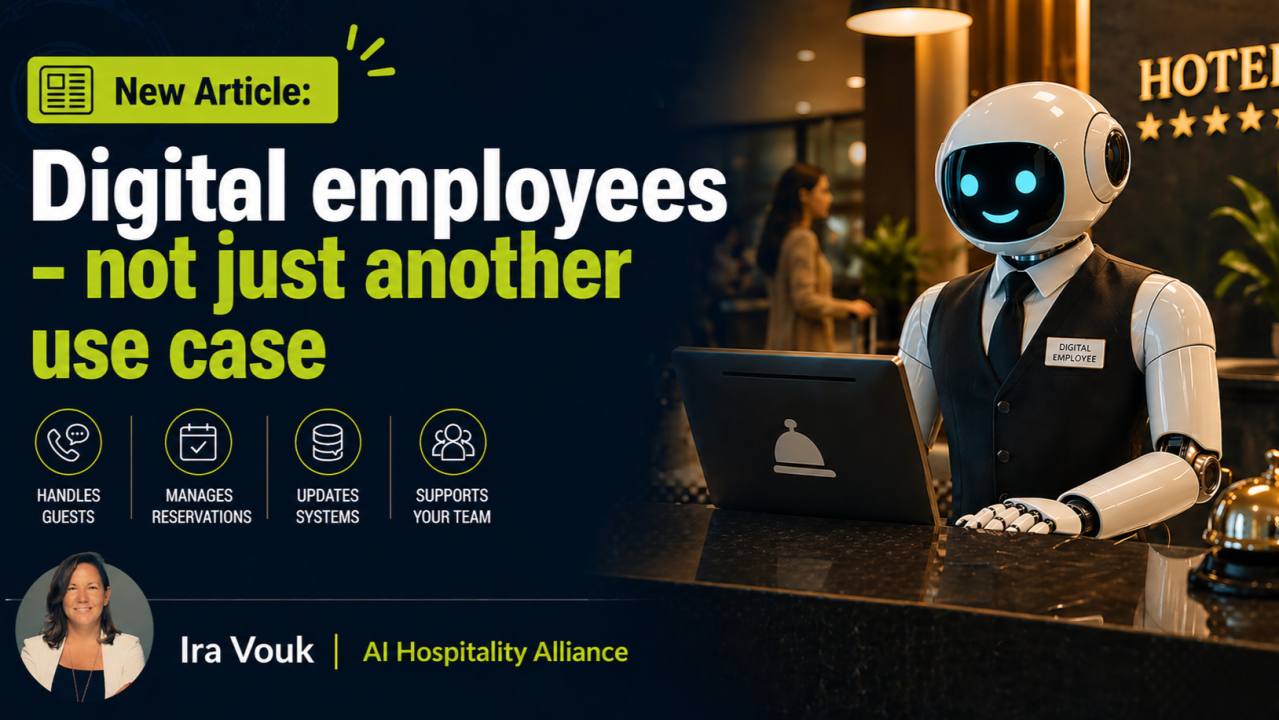
A few weeks ago, I started "playing" with digital employees. You know... playing. The same way someone in the 1800s was probably "playing" with electricity right before it quietly took over the world. Because once you actually see what this is capable of doing inside real hotel workflows, it stops feeling like a cool experiment and starts feeling like something much bigger.
And I am not talking about chatbots. Not the "Hi, how can I help you today?" kind that guests ignore until they find the phone number. I am talking about something very different. Something that does not just assist. It works.
That distinction is everything. For years, hospitality has been flirting with AI. We have had tools that help draft emails, suggest rates, answer basic guest questions. Helpful, yes. Occasionally impressive. But still assistants. Digital employees are a different category entirely.
They do not sit next to your systems. They sit inside them. They read, write, update, transfer, decide, execute. They do not just respond to a guest asking about availability. They check the PMS, create the reservation, update the CRM, trigger internal tasks, send confirmation, and move on to the next request before your front desk even finishes their coffee.
And yes, they know when to escalate to a human, which might be their most impressive skill. It means they are not just automating tasks. They are participating in operations.
From what I have seen and tested, we are already at a point where digital employees can handle a large portion of the intellectual work at the front desk: reservations, communication, data handling, coordination across systems. The remaining piece is the messy, emotional, unpredictable situations. In other words, hospitality.
What this actually looks like in a hotel
Let us break it down, because this is where it gets very real, very fast.
Guest-facing operations
Digital employees can already answer calls and messages, handle reservations, changes, and cancellations, respond to detailed guest questions, offer upsells based on real-time context, and follow up before, during, and after the stay. This is everything the industry has been trying to automate for years, but this time it actually works.
There is an important nuance here. If you are running a luxury property, replacing all human interaction with AI is not the goal. Upper-scale and luxury segments will move slower on the guest-facing side, not because they cannot adopt the technology, but because the human touch is still part of the product.
Back office operations
This is where digital employees shine. They quietly eliminate a surprising amount of operational friction. They can synchronize data across PMS, CRM, RMS, and other systems, clean and enrich guest profiles automatically, process emails and convert them into structured actions, assign and manage tasks, support revenue and distribution workflows, and assist sales teams with lead qualification and follow-ups.
In practical terms, this means fewer manual processes, fewer errors, and significantly less time spent switching between systems.
The real shift
Yes, digital employees improve speed, reduce costs, and increase accuracy. But the bigger shift is how they change the way we think about work.
When execution is no longer the bottleneck, everything else moves. The question shifts from "Do we have the resources?" to "What do we want to achieve?" Timelines become shorter, cost structures change, and the ability to execute increases dramatically.
This also means that clarity becomes a competitive advantage. The hotels that understand their processes and objectives will move faster than those that do not.
Reality check
This is still hospitality. We are dealing with fragmented systems, legacy infrastructure, and complex integrations. Adoption will not happen overnight. We will see pilots, then early adopters, and then broader industry uptake.
However, this is not a trend that will fade. Unlike some of the technologies that have been overhyped in recent years, digital employees directly impact cost, efficiency, and guest experience. That makes the business case difficult to ignore.
What is happening behind the scenes
There are already solutions operating today that are not positioning themselves as tools or assistants, but as fully embedded digital employees. They integrate with PMS, CRM, communication platforms, and operational systems. They read, update, create, resolve, follow up, and escalate when needed.
They are not theoretical. They are live, operating quietly inside real hospitality environments, handling real tasks and supporting real teams.
Where this is going
We are moving from a world where we ask whether we should use AI, to a world where we ask which roles we want our digital employees to take on. This shift will redefine job roles, team structures, budgets, and expectations of what normal operations look like.
I have been advising a number of investment firms in hospitality tech lately, and they all keep asking the same question: where will AI make the biggest impact, what is the one use case that will change everything?
For a long time, my answer was diplomatic. Everything. Distribution, operations, guest experience, revenue, marketing. All of it matters, all of it is being reshaped.
I think I am starting to change my mind.
Because if there is one layer that quietly sits across all of those areas and has the potential to accelerate every single one of them at once, it is this.
Digital employees are not just another use case. They are the execution layer.
And once execution is no longer the constraint, everything else moves faster than we are used to.
It is still early. But not early enough to ignore.